Nanotechnology industry in the Czech Republic
Nanotechnology is science, engineering, and technology conducted at the nanoscale, which is about 1 to 100 nanometers; it is the manipulation of matter on an atomic, molecular, and supramolecular scale. The Czech Republic has its nanotechnology network of collaborating businesses which has emerged around top research institutions involved in the most prestigious projects. These are CEITEC, the Regional Centre of Advanced Technologies and Materials, the Technical University of Liberec are undisputedly world-class centres of nanotechnology research. They are supported by a state-of-the-art research infrastructure and by the Czech Nanotechnology Cluster and Nanotechnology for Society funding programme.
Current successful investors in the sector are Microsoft, Skype, NetSuite, Tieto, Red Hat, SolarWinds and IBM.
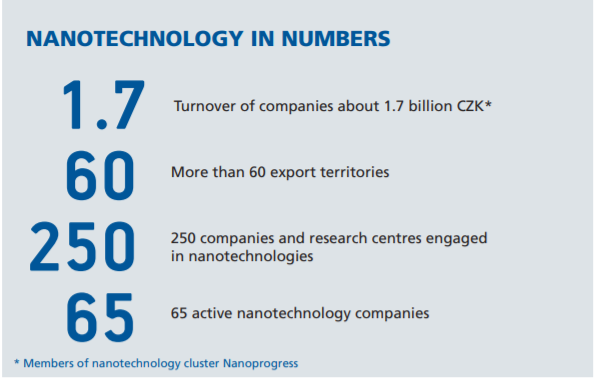 The Czech Republic is one of the world's incubators of nanotechnologies. Approximately four dozen companies and several scientific workplaces work with them according to the Association of the Nanotechnology Industry of the Czech Republic. To attract foreign investors, the Czech government makes attempts to portray the Czech Republic as a "nano-country" and invest money in innovations and nanotechnology. The country tries to support Universities and innovation centres and attract young people to study nanotechnologies as well.
In 2003, the Technical University of Liberec developed the world's first technology to allow the industrial production of nanofibrous nonwovens. The nanotechnological map of the Czech Republic has expanded at least to 8 regional research centres over the last 5 years, which are more or less engaged in applied nanotechnology research.
The Czech Republic is one of the world's incubators of nanotechnologies. Approximately four dozen companies and several scientific workplaces work with them according to the Association of the Nanotechnology Industry of the Czech Republic. To attract foreign investors, the Czech government makes attempts to portray the Czech Republic as a "nano-country" and invest money in innovations and nanotechnology. The country tries to support Universities and innovation centres and attract young people to study nanotechnologies as well.
In 2003, the Technical University of Liberec developed the world's first technology to allow the industrial production of nanofibrous nonwovens. The nanotechnological map of the Czech Republic has expanded at least to 8 regional research centres over the last 5 years, which are more or less engaged in applied nanotechnology research.
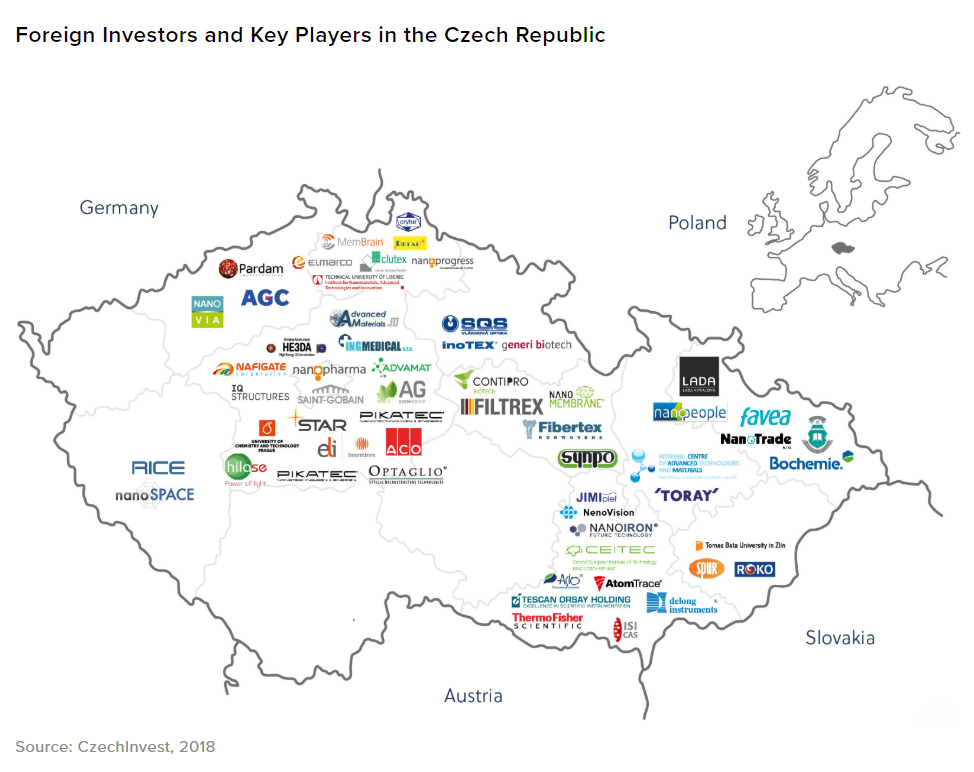 Their research was supported by the EU Structural Funds and the state budget of the Czech Republic for a total amount of EUR 170 million. Czech research and development recorded a dynamic increase in recent years as well. Expenditure on this area reached 85.1 billion over the last years. This is almost 10% more year-on-year. The R & D intensity, i.e. the share of these expenditures in GDP, was above the EU average and, above all, reached 2%. In terms of regions; the most successful is the South Moravian region.
Private enterprises, universities, public research institutions and other entities have spent nearly 600 billion crowns in research and development over the past ten years. "Enterprises have invested twice as much in the past three years as universities and three times more than public research institutions," said Martin Mana, Director of CSO's Statistics Development Division.
Most of the money is spent on research and development by companies active in the manufacturing, particularly in the automotive and mechanical engineering sectors. More is also being invested in the provision of ICT services and programming, biotechnology or nanotechnology. In the government sector, expenditures are directed mainly to the field of natural sciences, which is the domain of workplaces of the Academy of Sciences of the Czech Republic. At universities, research and development are most focused on technical sciences.
Their research was supported by the EU Structural Funds and the state budget of the Czech Republic for a total amount of EUR 170 million. Czech research and development recorded a dynamic increase in recent years as well. Expenditure on this area reached 85.1 billion over the last years. This is almost 10% more year-on-year. The R & D intensity, i.e. the share of these expenditures in GDP, was above the EU average and, above all, reached 2%. In terms of regions; the most successful is the South Moravian region.
Private enterprises, universities, public research institutions and other entities have spent nearly 600 billion crowns in research and development over the past ten years. "Enterprises have invested twice as much in the past three years as universities and three times more than public research institutions," said Martin Mana, Director of CSO's Statistics Development Division.
Most of the money is spent on research and development by companies active in the manufacturing, particularly in the automotive and mechanical engineering sectors. More is also being invested in the provision of ICT services and programming, biotechnology or nanotechnology. In the government sector, expenditures are directed mainly to the field of natural sciences, which is the domain of workplaces of the Academy of Sciences of the Czech Republic. At universities, research and development are most focused on technical sciences.
Back to BlogNanotechnology sector in the Czech Republic
The Czech Republic is one of the world's incubators of nanotechnologies. Approximately four dozen companies and several scientific workplaces work with them according to the Association of the Nanotechnology Industry of the Czech Republic. To attract foreign investors, the Czech government makes attempts to portray the Czech Republic as a "nano-country" and invest money in innovations and nanotechnology. The country tries to support Universities and innovation centres and attract young people to study nanotechnologies as well.
In 2003, the Technical University of Liberec developed the world's first technology to allow the industrial production of nanofibrous nonwovens. The nanotechnological map of the Czech Republic has expanded at least to 8 regional research centres over the last 5 years, which are more or less engaged in applied nanotechnology research.
Their research was supported by the EU Structural Funds and the state budget of the Czech Republic for a total amount of EUR 170 million. Czech research and development recorded a dynamic increase in recent years as well. Expenditure on this area reached 85.1 billion over the last years. This is almost 10% more year-on-year. The R & D intensity, i.e. the share of these expenditures in GDP, was above the EU average and, above all, reached 2%. In terms of regions; the most successful is the South Moravian region.
Private enterprises, universities, public research institutions and other entities have spent nearly 600 billion crowns in research and development over the past ten years. "Enterprises have invested twice as much in the past three years as universities and three times more than public research institutions," said Martin Mana, Director of CSO's Statistics Development Division.
Most of the money is spent on research and development by companies active in the manufacturing, particularly in the automotive and mechanical engineering sectors. More is also being invested in the provision of ICT services and programming, biotechnology or nanotechnology. In the government sector, expenditures are directed mainly to the field of natural sciences, which is the domain of workplaces of the Academy of Sciences of the Czech Republic. At universities, research and development are most focused on technical sciences.